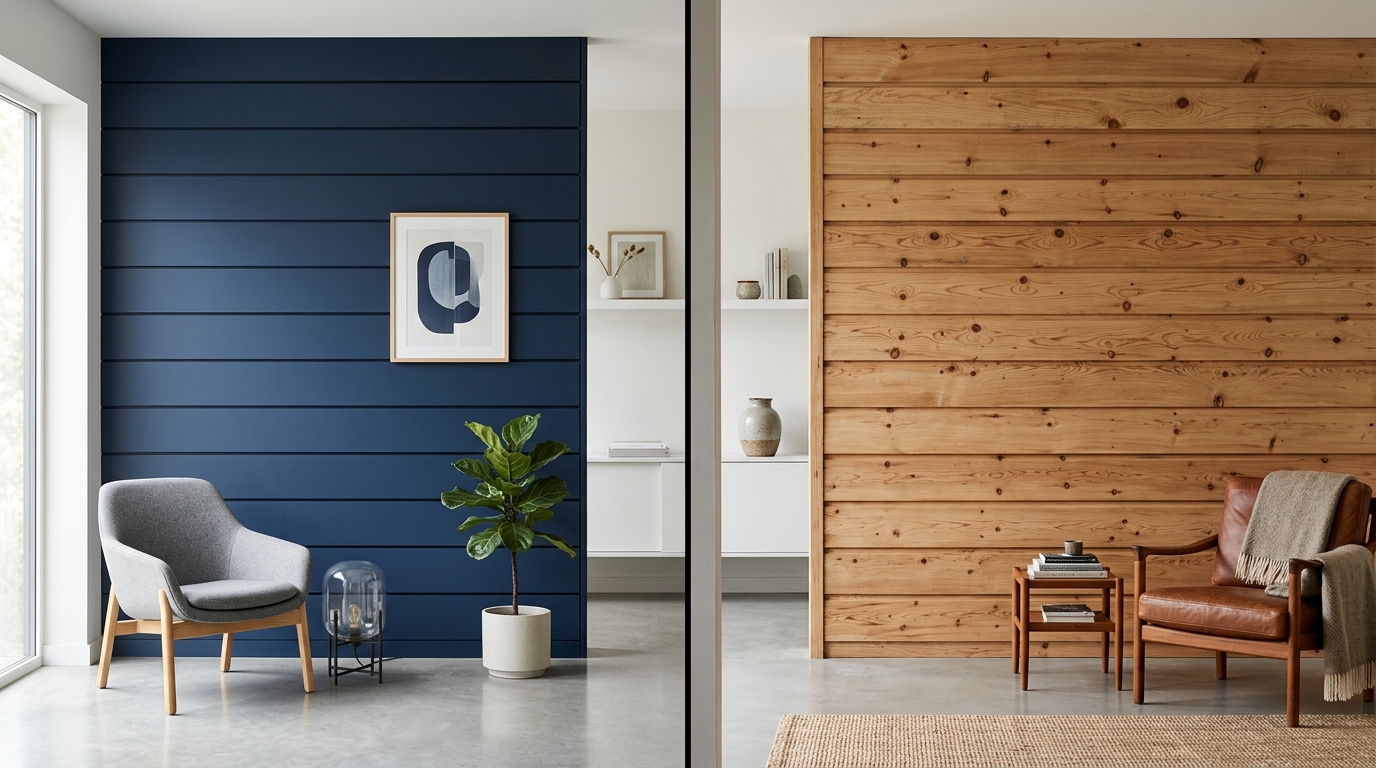
While the terms “shiplap” and “nickel gap” are frequently used interchangeably across Pinterest boards, home renovation shows, and interior design magazines, they refer to two fundamentally distinct milling profiles with different joinery mechanics, aesthetic shadow lines, installation speeds, and wall coverage calculations.
Choosing the wrong profile for your room can lead to unexpected material shortages, visible nail heads, or a finish that clashes with your home’s architectural style.
In this comprehensive carpentry breakdown, master carpenter Thomas Clark compares traditional shiplap against modern nickel gap paneling across every key metric—from milling geometry and expansion tolerances to cost and room suitability.
Quick Comparison Matrix: Shiplap vs. Nickel Gap
| Feature | Traditional Shiplap | Nickel Gap Paneling |
|---|---|---|
| Joint Profile | Half-lap rabbet joint (overlapping lips) | Tongue-and-groove with built-in shoulder stop |
| Reveal / Shadow Gap | Tight overlap (0” to 1/16” organic gap) | Consistent 1/8” (0.125”) distinct channel |
| Fastener Concealment | Partial blind-nailing (face nails often needed) | 100% Blind-fastened through tongue |
| Milling Alignment | Manual alignment / variable lap | Self-spacing via factory-milled shoulder stop |
| Primary Design Style | Rustic, Modern Farmhouse, Coastal Cottage | Contemporary, Scandinavian, Modern Minimalist |
| Moisture Resistance | Moderate (overlapping lips shed water) | High (interlocking barrier prevents air infiltration) |
| Average Cost / Sq. Ft. | $2.50 – $5.50 (Primed Pine / MDF) | $3.50 – $7.50 (Engineered Wood / PVC) |
| Installation Speed | Moderate (requires manual leveling checks) | Faster (tongue-and-groove self-registers) |
The Anatomy of Traditional Shiplap
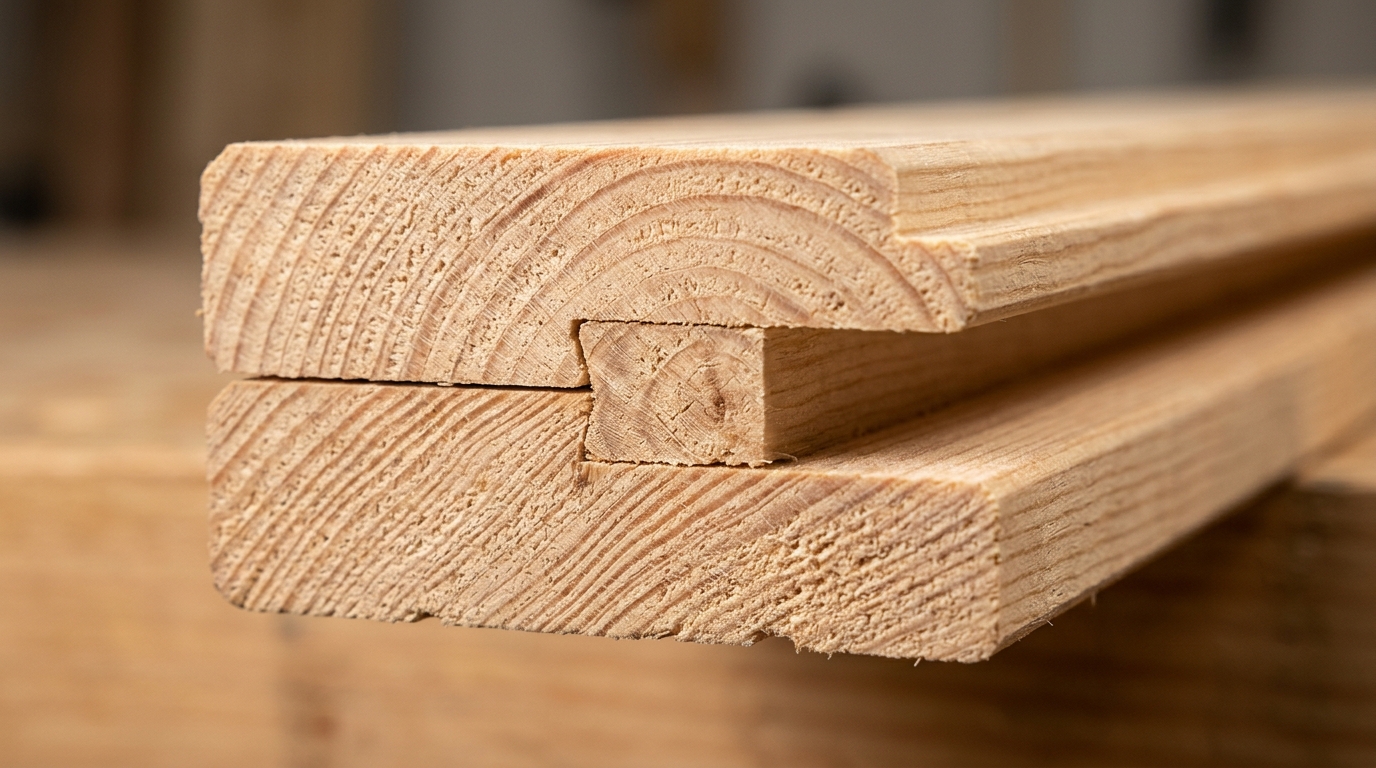
Traditional shiplap originated centuries ago as protective exterior cladding for wooden barns, coastal sheds, and ship hulls.
How the Joint Works:
- Each board features an L-shaped notch (rabbet) milled along the top and bottom opposing edges.
- When installed, the bottom rabbet of the upper board overlaps the top rabbet of the lower board by exactly ½ inch.
- As the boards fit together, they create a natural weather barrier.
Key Characteristics:
- Organic, Variable Seams: Because natural wood swells in summer and shrinks in winter, the seams between traditional shiplap boards naturally expand and contract slightly, creating an authentic, hand-crafted farmhouse aesthetic.
- Face Nailing Required on Wider Planks: While narrow 1×4 shiplap can be blind-nailed through the upper rabbet, wider 1×6 and 1×8 planks require face nails near the bottom edge to prevent cupping, leaving small nail holes that must be spackled and sanded.
🧮 Need to calculate traditional shiplap? Use our Shiplap Takeoff Calculator to calculate board coverage accounting for the ½” rabbet overlap.
The Anatomy of Modern Nickel Gap
Nickel gap was engineered specifically for modern interior architecture to eliminate the uneven gaps of rustic shiplap and provide razor-sharp, uniform shadow lines across entire rooms.
How the Joint Works:
- Nickel gap boards utilize a modified tongue-and-groove (T&G) milling.
- The tongue is engineered with an extended shoulder that prevents the tongue from bottoming out inside the adjacent groove.
- When two boards are pushed together firmly, the shoulder stop leaves a mathematically perfect ⅛-inch (0.125”) shadow reveal—the exact thickness of a standard United States five-cent nickel coin.
Key Characteristics:
- Self-Spacing Precision: In traditional carpentry, installers had to slide physical nickels or tile spacers between boards to maintain consistent spacing. Modern nickel gap boards feature factory-milled spacer stops, making installation up to 30% faster.
- 100% Concealed Fasteners: Every nail is driven at a 45-degree angle through the tongue before the next board’s groove covers it. The result is a seamless wall with zero visible nail heads on the face.
💡 Working with reveal profiles? Calculate exact wall courses with our dedicated Nickel Gap Calculator.
Visual Comparison: When to Choose Each Profile
TRADITIONAL SHIPLAP (Rabbet Overlap)
┌───────────────────────────────────────┐
│              Board Face               │
└──────────────┬────────────────────────┘
               │ ◄── 1/2" Overlapping Rabbet (Tight/Subtle Gap)
┌──────────────┴────────────────────────┐
│              Board Face               │
└───────────────────────────────────────┘

MODERN NICKEL GAP (Tongue & Groove Reveal)
┌───────────────────────────────────────┐
│              Board Face               │
└─────────┬─────────────────────────────┘
          │ ◄── Exact 1/8" Deep Shadow Channel
┌─────────┴─────────────────────────────┐
│              Board Face               │
└───────────────────────────────────────┘
Choose Traditional Shiplap If:
- You are remodeling a Modern Farmhouse, Craftsman bungalow, or historical coastal cottage.
- You want the natural wood texture and subtle variation of authentic rustic wood.
- You are working on a budget and want the most cost-effective lumber options (raw pine or standard MDF shiplap).
- You plan to install horizontal accent walls behind a brick fireplace, entryway drop zone, or mudroom bench.
Choose Nickel Gap If:
- You are designing a Contemporary, Scandinavian, Mid-Century Modern, or Luxury Transitional space.
- You want razor-sharp, architectural lines that look crisp under modern recessed ceiling pot lights.
- You want a flawless, ultra-smooth painted surface without having to patch and sand hundreds of face nail holes.
- You are paneling bathrooms, laundry rooms, or ceilings where moisture control and concealed blind fasteners are paramount.
Room-by-Room Suitability Guide
1. Living Rooms & Master Bedrooms
- Best Choice: Nickel Gap for modern transitional homes; Traditional Shiplap for rustic farmhouse homes.
- Orientation: Horizontal orientation visually widens narrow bedrooms and gives living room accent walls an expansive, grounded feel.
2. Bathrooms & Powder Rooms
- Best Choice: Nickel Gap (in Cellular PVC or Moisture-Resistant MDF).
- Why: Interlocking tongue-and-groove joints prevent moisture and steam from penetrating behind the drywall. Choose cellular PVC if installed directly behind bathroom sinks or tubs.
3. Ceilings & Soffits
- Best Choice: Nickel Gap / Tongue-and-Groove.
- Why: Traditional shiplap can sag slightly under gravity when face-nailed into ceiling joists. Interlocking T&G nickel gap planks lock mechanically into one another along the entire length, ensuring a flat, secure overhead span.
🏠 Planning a ceiling project? Check out our dedicated Shiplap Ceiling Takeoff Calculator.
Dimensional Math: Wall Coverage Difference
When ordering lumber, never assume a 6-inch shiplap board and a 6-inch nickel gap board provide the same coverage:
-
Nominal 1×6 Traditional Shiplap:
- Actual overall board width: 5.375”
- Rabbet overlap deduction: -0.500”
- Net vertical coverage: 4.875 inches (4⅞”)
-
Nominal 1×6 Nickel Gap (T&G):
- Exposed face width: 5.000”
- Shadow gap reveal: +0.125” (⅛”)
- Net vertical coverage: 5.125 inches (5⅛”)
On an 8-foot-tall wall (96 inches high):
- Traditional Shiplap requires: 20 horizontal courses (96 ÷ 4.875 = 19.7 rows).
- Nickel Gap requires: 19 horizontal courses (96 ÷ 5.125 = 18.7 rows).
That single difference means traditional shiplap requires 5% to 8% more total linear feet of lumber to cover the exact same wall area!
Frequently Asked Questions (FAQ)
1. Is nickel gap more expensive than traditional shiplap?
Yes, typically by 15% to 25%. Nickel gap boards require more complex multi-pass precision milling at the factory to create the interlocking tongue, groove, and built-in shoulder spacer. However, you save on labor time because you do not need to fill face nail holes or manually gauge each seam with coins.
2. Can I install nickel gap shiplap vertically?
Yes! Vertical nickel gap paneling is one of the top interior design trends today. Installing vertical boards draws the eye upward, making standard 8-foot ceilings feel significantly taller. When installing vertically, make sure you install horizontal 2×4 blocking or 1×3 furring strips behind the drywall to provide solid nail backing every 16 inches.
3. Can I use real nickels to space standard boards?
Yes, you can buy standard square-edge 1×6 pine boards and manually insert real 5-cent nickel coins between courses as you nail them. However, standard square-edge boards do not overlap, meaning the wall drywall behind the gap will be visible unless you paint a dark stripe on the drywall behind each seam prior to installation.
4. What color should I paint the wall behind shiplap?
If installing boards with a reveal gap, paint a 2-inch black or dark charcoal stripe along the wall where each horizontal seam will land. This ensures that any drywall visible through the shadow gap looks like a rich, deep shadow rather than bare white sheetrock.
5. Which profile is easier for a first-time DIYer?
Nickel Gap with factory-milled stops is generally easier because the interlocking tongue-and-groove profile automatically levels and spaces each row. Traditional shiplap requires more attention to ensure overlapping rabbets stay level across long wall runs.