When embarking on a shiplap project, selecting the right lumber substrate or composite material is just as critical as getting your wall measurements right.
Choosing the wrong material can lead to warped boards in humid bathrooms, bleeding knots through fresh white paint, or excessive costs in standard living areas. From ultra-smooth engineered MDF and traditional knotty pine to weather-resistant Western Red Cedar and 100% waterproof cellular PVC, each material offers distinct trade-offs in price, weight, durability, and finishing requirements.
In this comprehensive guide, licensed carpenter Thomas Clark evaluates the five most popular shiplap materials to help you select the ideal substrate for your specific room, budget, and environmental conditions.
Shiplap Material Master Comparison Table
| Material Type | Cost / Sq. Ft. | Moisture Tolerance | Warping Risk | Best For | Indoor / Outdoor |
|---|---|---|---|---|---|
| Pre-Primed MDF | $2.00 – $4.00 | Low (Swells if wet) | Extremely Low | Dry interior accent walls, bedrooms, ceilings | Indoor Only |
| Finger-Jointed Pine (FJ) | $3.00 – $5.50 | Moderate | Low (Engineered joints) | Living rooms, hallways, dining rooms | Indoor Only |
| Natural Knotty Pine | $2.50 – $4.50 | Moderate | Moderate to High | Rustic cabins, stained woodwork, farmhouse | Indoor / Covered Porch |
| Western Red Cedar | $6.00 – $12.00 | Very High (Natural oils) | Low | Saunas, exterior siding, luxury bathrooms | Indoor & Outdoor |
| Cellular PVC | $5.00 – $9.50 | 100% Waterproof | Zero (Impervious to rot) | Showers, steam rooms, exterior cladding | Indoor & Outdoor |
💰 Calculate Total Project Costs: Compare material budget tiers instantly using our Shiplap Cost Estimator.
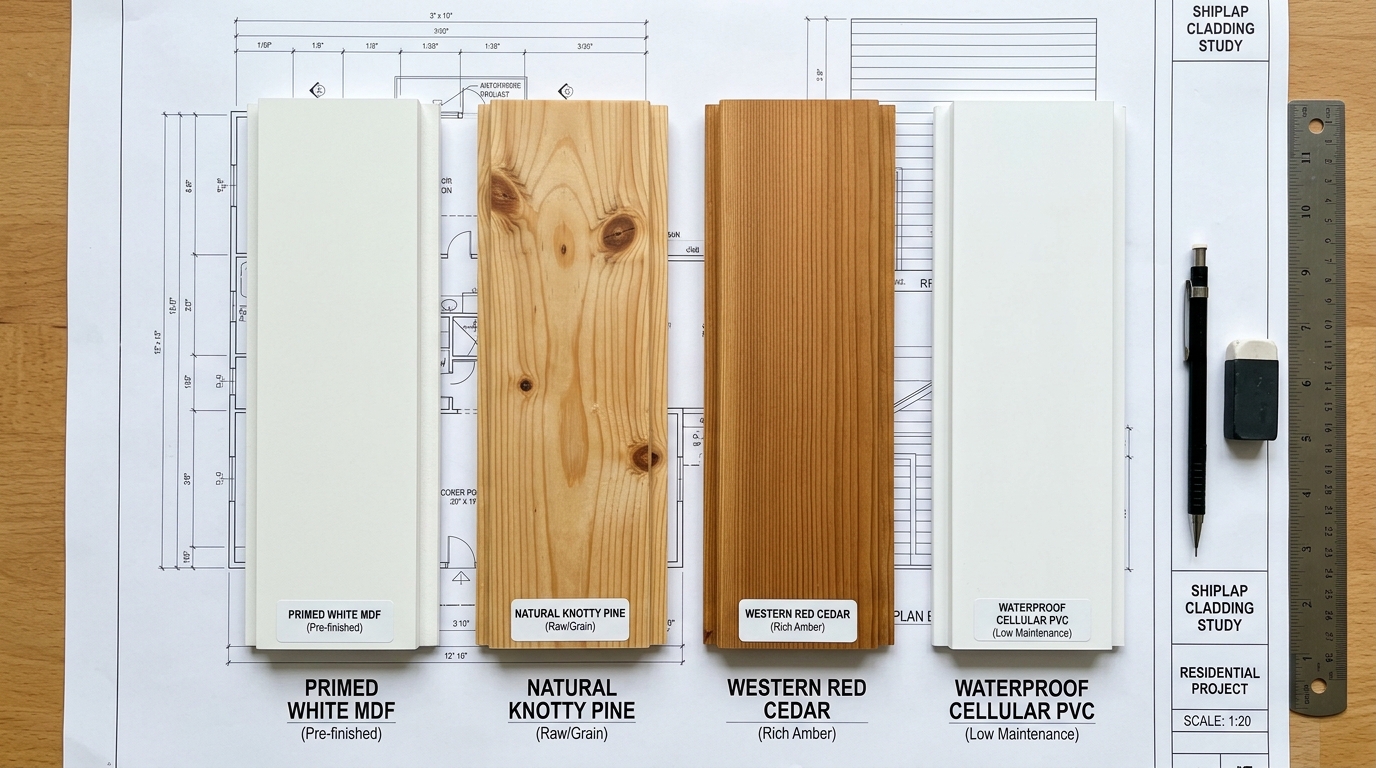
1. Pre-Primed MDF (Medium Density Fiberboard)
Overview & Pros
Medium-Density Fiberboard (MDF) is an engineered wood composite manufactured by breaking down hardwood and softwood residuals into fine wood fibers, combining them with wax and resin binders, and pressing them into dense panels under extreme heat and pressure.
- Flawless, Grain-Free Paint Finish: Because MDF has no natural grain or growth rings, it yields an ultra-smooth, factory-flat painted surface without brush drag.
- Zero Knots or Resin Bleed: Traditional pine contains sap knots that can bleed through white paint years later (tannin bleed). MDF is 100% knot-free.
- Dimensionally Stable: MDF does not cup, twist, or warp like natural solid lumber.
- Most Affordable: At $2.00 to $4.00 per square foot, it is the most budget-friendly option for large living room accent walls.
Cons & Limitations
- Vulnerable to Water Damage: If exposed to standing water or constant bathroom steam, standard MDF fibers absorb moisture and swell permanently like a sponge.
- Heavy & Brittle: MDF boards are heavier than pine, require sharp carbide blades to cut cleanly, and generate fine dust that requires a respirator mask during cutting.
2. Solid Pine (Finger-Jointed vs. Knotty Pine)
Pine has been the traditional American cladding wood of choice for over two centuries.
A. Finger-Jointed Pre-Primed Pine (Best for Paint Grade)
- Finger-jointed pine is made by interlocking short defect-free segments of solid pine with high-strength epoxy joints.
- Pros: It combines the natural strength and lightweight handling of real solid wood with the straightness and knot-free stability of engineered boards. It holds nails exceptionally well.
B. Solid Knotty Raw Pine (Best for Staining & Rustic Looks)
- Pros: Features visible amber knots, natural growth rings, and rich character. It can be stained in walnut, weathered gray, or natural clear coats.
- Cons: Requires thorough sealing with shellac-based primer (such as Zinsser B-I-N) over every knot prior to painting to prevent yellow sap stains from bleeding through white paint.
3. Western Red Cedar (The Luxury & Moisture Champion)
Western Red Cedar (Thuja plicata) is one of the world’s most prized architectural woods.
- Natural Preservatives: Cedar contains natural chemical compounds called thujaplicins that make the wood naturally resistant to rot, mold, fungi, and termite infestation without chemical treatment.
- Dimensional Stability in High Humidity: Cedar has an exceptionally low shrinkage coefficient, making it the premier choice for spa bathrooms, indoor pool rooms, saunas, and covered outdoor porch ceilings.
- Acoustic & Thermal Insulation: Cedar’s cellular structure contains millions of tiny air pockets that absorb sound and provide natural insulation.
- Drawback: Premium price point ($6.00 to $12.00+ per sq. ft.).
4. Cellular PVC (100% Waterproof Synthetic)
Cellular PVC (such as Azek or Royal Building Products) is a non-porous polyvinyl chloride material with a closed-cell structure that completely repels water.
- 100% Impervious to Moisture: Can be installed directly in walk-in shower vestibules, laundry washrooms, outdoor eaves, and oceanfront coastal siding exposed to salt spray.
- Zero Rot, Mold, or Insect Damage: Never rots, splinters, or decays.
- Low Maintenance: Wipes clean easily with soap and water; does not require repainting unless a custom color is desired.
- Installation Tip: Requires specialized Cortex hidden screw systems or stainless steel siding nails, as standard brad nails may not hold under thermal expansion.
🌧️ Planning an exterior project? Calculate weather envelope takeoffs with our Exterior Shiplap Siding Calculator.
Material Recommendation by Room
┌───────────────────────────┬───────────────────────────┐
│ Room / Application        │ Recommended Material      │
├───────────────────────────┼───────────────────────────┤
│ Living Room / Bedroom     │ Pre-Primed MDF or FJ Pine │
│ Fireplace Feature Wall    │ MDF or Solid Poplar / Pine│
│ Powder Room (Half Bath)   │ Pre-Primed MDF / Pine     │
│ Full Bath / Shower Area   │ Cellular PVC or Cedar     │
│ Covered Porch Ceiling     │ Western Red Cedar or Pine │
│ Exterior Siding           │ Cedar or Cellular PVC     │
└───────────────────────────┴───────────────────────────┘
Frequently Asked Questions (FAQ)
1. Can I use MDF shiplap in a bathroom?
You can safely use MDF in a half-bath (powder room) with only a toilet and sink. However, in a full bathroom with a shower or bathtub, the humidity and steam will eventually cause MDF edges to swell and delaminate. For full bathrooms, choose moisture-resistant (MR) MDF, pre-primed pine, cedar, or cellular PVC.
2. How do I stop pine knots from bleeding through white paint?
Always apply two coats of a shellac-based primer (e.g. Zinsser B-I-N) directly over every knot before painting. Standard water-based latex primers will not block wood tannins, which will show through white paint as yellow or brown rings within 6 to 12 months.
3. Is PVC shiplap paintable?
Yes! Cellular PVC can be painted with 100% acrylic exterior latex paint. However, to prevent thermal warping in direct sunlight, select paint colors with a Light Reflectance Value (LRV) of 55 or higher (light or medium shades). Dark paints absorb excessive solar heat and can distort synthetic vinyl boards.
4. What is the lightest material for ceiling installations?
Western Red Cedar and Finger-Jointed Pine are significantly lighter than MDF. Solid cedar weighs approximately 1.1 lbs per square foot, making it much easier to lift and secure overhead on ceilings compared to dense MDF (which weighs ~1.8 lbs per square foot).
5. What wood is best if I want to stain my shiplap rather than paint it?
Select Clear Grade White Pine, Knotty Alder, White Oak, or Western Red Cedar. These species take wood stains evenly and showcase rich, organic grain patterns.